Why a Professional Law Firm Website Matters
Choosing an attorney is an important decision.
Potential clients often research a law firm carefully before making contact. Your website gives you an opportunity to communicate your professionalism, experience, practice areas, and approach before that first conversation.
A well-designed law firm website can help you:
- Establish credibility
- Explain your practice areas
- Introduce your attorneys
- Showcase relevant experience
- Provide useful legal information
- Display genuine client reviews where appropriate
- Explain your consultation process
- Highlight the locations you serve
- Make your phone number easy to find
- Generate consultation enquiries
- Answer common questions
- Support your local online presence
Your website should not simply list your legal services.
It should help potential clients understand your firm and feel confident taking the next step.

Everything Your Law Firm Website Needs
We design law firm websites around the information potential clients commonly look for before contacting an attorney.
Practice Areas
Clearly present the areas of law your firm handles, such as:
- Personal injury
- Family law
- Criminal defense
- Business law
- Estate planning
- Employment law
- Real estate law
- Immigration law
- Bankruptcy
- Civil litigation
- Workers’ compensation
- Probate
- Intellectual property
- Tax law
- Insurance law
Your actual practice areas can be customized around your firm.
Attorney Profiles
Introduce your attorneys with professional photographs, biographies, education, qualifications, bar admissions, professional memberships, and relevant experience.
About Your Firm
Tell visitors about your firm, its history, values, approach, and the people behind it.
Client Reviews
Where appropriate and permitted, display genuine client testimonials to provide additional insight into the client experience.
Consultation Requests
Give potential clients a straightforward way to contact your firm and request a consultation.
Office Information
Make your address, phone number, office hours, directions, and other relevant information easy to find.

Built Around Your Law Firm
Your website can include the features your firm actually needs.
- Professional custom design
- Mobile-responsive layout
- WordPress CMS
- Easy-to-update content
- Practice area pages
- Attorney profile pages
- Team information
- Client testimonials where appropriate
- Case information where appropriate
- Consultation request forms
- Contact forms
- Click-to-call buttons
- Google Maps integration
- Office location information
- Legal FAQs
- Blog or legal resources
- Strong calls to action
- Social media links
- SSL/HTTPS
- Sitemap
- Search-engine-friendly structure
- Fast-loading pages
The exact features can be tailored to your law firm’s practice areas, size, location, and goals.

Turn Website Visitors Into Consultation Requests
A law firm website should make it clear how potential clients can take the next step.
Depending on your firm, that might mean:
Request a Consultation
Give potential clients a clear way to request an initial consultation.
Call Your Firm
Keep your phone number prominent so visitors can quickly speak with your office.
Contact an Attorney
Provide a straightforward contact option for people who want to discuss their situation.
Explore a Practice Area
Help visitors find the legal service relevant to their situation.
Find Your Office
Make your location, directions, parking information where useful, and other office details easy to find.
Ask a General Question
Provide a contact option for visitors who need additional information before scheduling.
Clear calls to action can be placed throughout the website so visitors don’t have to search for how to contact your firm.

Designed for People Searching on Their Phones
Potential clients frequently research attorneys and law firms from smartphones.
They may be searching for legal help while away from their computer, checking your practice areas, reading about an attorney, looking for your phone number, or trying to schedule a consultation.
Your website should make those tasks simple.
A mobile-friendly law firm website can make it easy to:
- Find your phone number
- Call your office
- Explore practice areas
- Meet your attorneys
- Read reviews where appropriate
- Request a consultation
- Find your office
- Read legal resources
- Submit a contact form
A strong mobile experience can make it easier for a potential client to move from researching your firm to contacting your office.

A Website Built With Local Clients in Mind
Many law firms serve specific cities, counties, states, or regions.
Your website should make it clear where your attorneys practice and which communities you serve.
You can highlight:
Areas Served
Clearly identify your primary geographic markets.
Practice Areas
Explain the types of legal matters your firm handles.
Local Knowledge
Provide useful information relevant to the communities and jurisdictions where you practice.
Office Locations
If your firm has multiple offices, provide clear information about each location.
Your Legal Team
Introduce the attorneys who serve clients in your target markets.
Local information can also provide a useful foundation for broader local marketing and SEO efforts.

Explain Your Practice Areas Clearly
Legal terminology can be unfamiliar to people who aren’t attorneys.
Your website can explain your practice areas in clear, accessible language.
For example, a page about personal injury law can explain the types of matters the firm handles and how prospective clients can contact the firm.
Similarly, pages for:
- Family law
- Criminal defense
- Business law
- Estate planning
- Employment law
- Immigration
- Real estate law
- Civil litigation
can provide visitors with useful information about the firm’s services.
The goal is not to overwhelm visitors with legal terminology.
It is to help them understand whether your firm handles the type of legal matter they are researching.
Legal content should be reviewed and approved by the appropriate attorney before publication.

Introduce Your Attorneys
Potential clients often want to know who will be handling their legal matter.
A dedicated attorney section can introduce:
- Attorneys
- Partners
- Associates
- Legal professionals
- Relevant support team members
Each attorney profile can include appropriate information such as:
- Professional photograph
- Name and title
- Education
- Bar admissions
- Practice areas
- Professional memberships
- Awards or recognition where appropriate
- Professional experience
- Biography
A well-presented attorney profile helps visitors become familiar with the people behind your firm.

Showcase Your Law Firm
Your website can give potential clients a better sense of your firm before they contact you.
Consider showcasing:
- Office exterior
- Reception area
- Conference rooms
- Attorney offices
- Team photographs
- Professional events
- Community involvement where appropriate
- Firm history
- Awards or recognition where appropriate
Professional photography can make the firm feel more established and familiar.
Where possible, authentic photographs of your actual attorneys and offices can make the website feel more personal and credible than generic stock photography.

Provide Useful Legal Resources
A law firm website can provide value before a potential client ever contacts the firm.
A legal resource section or blog can cover topics relevant to your practice areas.
Potential content can include:
- Answers to common questions
- Explanations of legal processes
- General legal information
- Changes in relevant laws
- Guides for potential clients
- Frequently asked questions
- Local legal information
Useful content can help visitors better understand the topic they are researching.
However, legal information should be written carefully and reviewed by the appropriate attorney. Website content should not imply that general information constitutes legal advice or creates an attorney-client relationship.

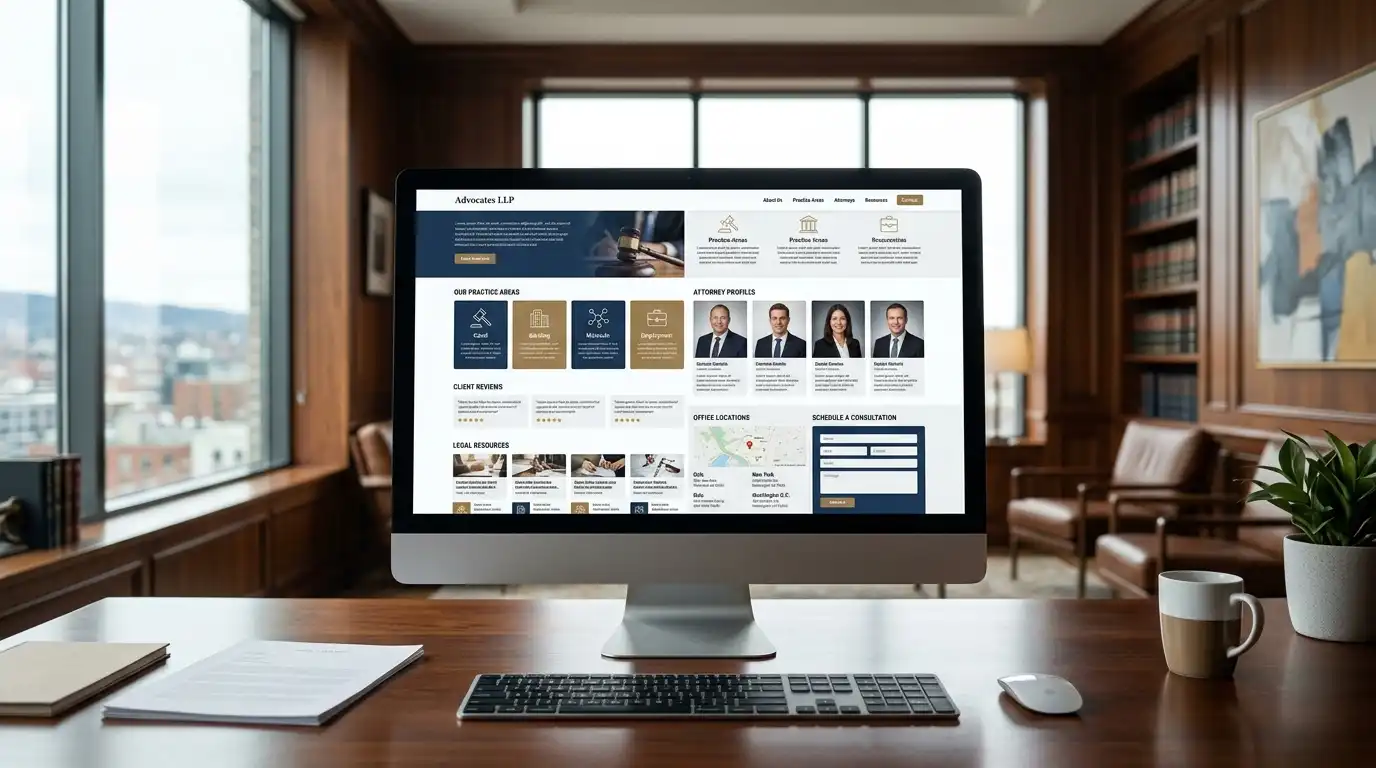
What Should a Law Firm Website Look Like?
A typical law firm website might include:
Home
Introduce your firm, primary practice areas, attorneys, trust signals, locations, and consultation options.
About
Tell visitors about your firm, history, values, attorneys, and approach.
Practice Areas
Explain each area of law your firm handles.
Attorneys
Introduce your lawyers with professional profiles.
Results / Experience
Where appropriate and legally permitted, provide information about relevant experience or representative matters.
Reviews
Highlight genuine client feedback where appropriate and compliant with applicable professional rules.
Resources / Blog
Publish useful legal information relevant to your practice areas.
FAQs
Answer common questions about your services, consultations, office procedures, and other appropriate topics.
Contact
Provide your phone number, consultation request form, address, office hours, map, and other relevant information.
The structure can be customized around your law firm’s practice areas and requirements.
Common Law Firm Website Mistakes
A law firm website can lose potential clients without the firm realizing it.
Outdated Design
A dated website can make a professional law firm appear less established than it actually is.
Your website should accurately represent your current firm.
Unclear Practice Areas
Visitors should quickly understand whether your firm handles their type of legal matter.
No Attorney Profiles
Potential clients often want to know who they are considering hiring.
Professional attorney profiles can provide useful context.
Difficult Contact Process
Visitors should be able to quickly find your phone number or consultation request option.
No Local Information
If your practice serves specific communities or jurisdictions, make that information clear.
Poor Mobile Experience
Potential clients may search for legal help from their phones.
Your website should be easy to navigate on smaller screens.
Generic Legal Content
Your website should reflect your actual practice areas, attorneys, experience, locations, and approach.
Outdated Information
Incorrect office hours, attorney information, practice areas, addresses, or contact information can create unnecessary confusion.
Keep important information current.
Overly Complicated Legal Language
Visitors should be able to understand what your firm does without needing a legal dictionary.
Use clear language wherever possible while maintaining accuracy.
Your Website Should Represent Your Law Firm
Every law firm has its own attorneys, practice areas, experience, clients, history, and approach.
Your website should reflect those differences.
We can build the website around your:
- Brand
- Practice areas
- Attorneys
- Team
- Locations
- Experience
- Client reviews where appropriate
- Legal resources
- Firm history
- Professional achievements
- Business goals
The result should be a website that feels like your actual law firm rather than a generic legal template.

Our Law Firm Website Design Process
1. Understand Your Firm
We start by learning about your law firm, practice areas, attorneys, locations, clients, and goals.
2. Plan the Website
We determine the pages, practice-area structure, attorney profiles, calls to action, contact process, and resources.
3. Design the Website
We create a professional design around your firm’s brand and positioning.
4. Build the Website
The website is built using WordPress and designed to work across desktop, tablet, and mobile devices.
5. Review & Refine
You review the website and provide feedback so we can make the necessary adjustments.
6. Launch
Once everything is ready, your new law firm website goes live.

Law Firm Website Design FAQs
How much does a law firm website cost?
The cost depends on the size, features, content requirements, number of practice areas, number of attorneys, and functionality needed. A small attorney website will generally cost less than a larger law firm website with numerous practice-area pages, attorney profiles, locations, resources, and advanced lead-generation features.
How long does it take to build a law firm website?
The timeline depends on the size and complexity of the project. A typical small law firm website can often be completed within a few weeks, depending on how quickly content, photographs, feedback, and approvals are provided.
Can you redesign my existing law firm website?
Yes. An existing law firm website can be redesigned and rebuilt with a modern structure, improved mobile experience, clearer calls to action, and updated content.
Can I update the website myself?
Yes. WordPress allows authorized users to update many parts of the website without needing to edit code.
Will my law firm website work on mobile phones?
Yes. The website should be designed to provide a usable experience across smartphones, tablets, laptops, and desktop computers.
Can you add my practice areas?
Yes. Your website can include dedicated pages or sections for the specific areas of law your firm handles.
Can you add attorney profiles?
Yes. Professional attorney profile pages can introduce your lawyers, qualifications, practice areas, experience, and professional background.
Can potential clients request consultations through the website?
Yes. Consultation request forms can be added to make it easier for potential clients to contact your firm.
Can you add multiple office locations?
Yes. If your firm has multiple locations, the website can provide dedicated information for each office.
Can you add legal FAQs?
Yes. FAQ sections can answer appropriate general questions about your firm’s services, consultation process, office procedures, and other relevant topics.
Can you add a legal blog?
Yes. A WordPress website can include a blog or legal resource section for publishing useful information related to your practice areas.
Can you add client reviews?
Yes. Genuine client testimonials can be incorporated where appropriate and consistent with applicable professional rules.
Can you help with SEO?
The website can be built with a search-engine-friendly structure and appropriate on-page foundations. Ongoing SEO is a separate service and can be added when needed.