If you run a small business without a website, you’ve probably heard the same advice over and over:
“You need a website.”
But is that actually true?
What if you already have a Facebook page?
What if you get most of your customers through referrals?
What if you have a Google Business Profile?
What if your Instagram account is doing really well?
What if you’re just starting the business and don’t want to spend money on a website yet?
The honest answer is:
Not every business needs a website immediately.
But for many small businesses, there comes a point where not having one starts creating unnecessary problems.
The better question isn’t:
“Does every small business need a website?”
It’s:
“Is my business missing opportunities because I don’t have a website?”
This guide will help you figure that out.
The Short Answer
If your business depends on finding new customers, generating leads, building credibility, appearing in search results, or explaining your services before someone contacts you, a website is usually a worthwhile investment.
But you don’t necessarily need a huge website.
A one-page website can be enough for some businesses.
A five-page website may be enough for others.
A company with dozens of services, multiple locations, ecommerce, bookings, or other complex requirements may need something much larger.
The goal isn’t to build the biggest website you can afford.
The goal is to build the smallest website that does what your business actually needs.
That’s an important distinction.
First, Ask Yourself These 10 Questions
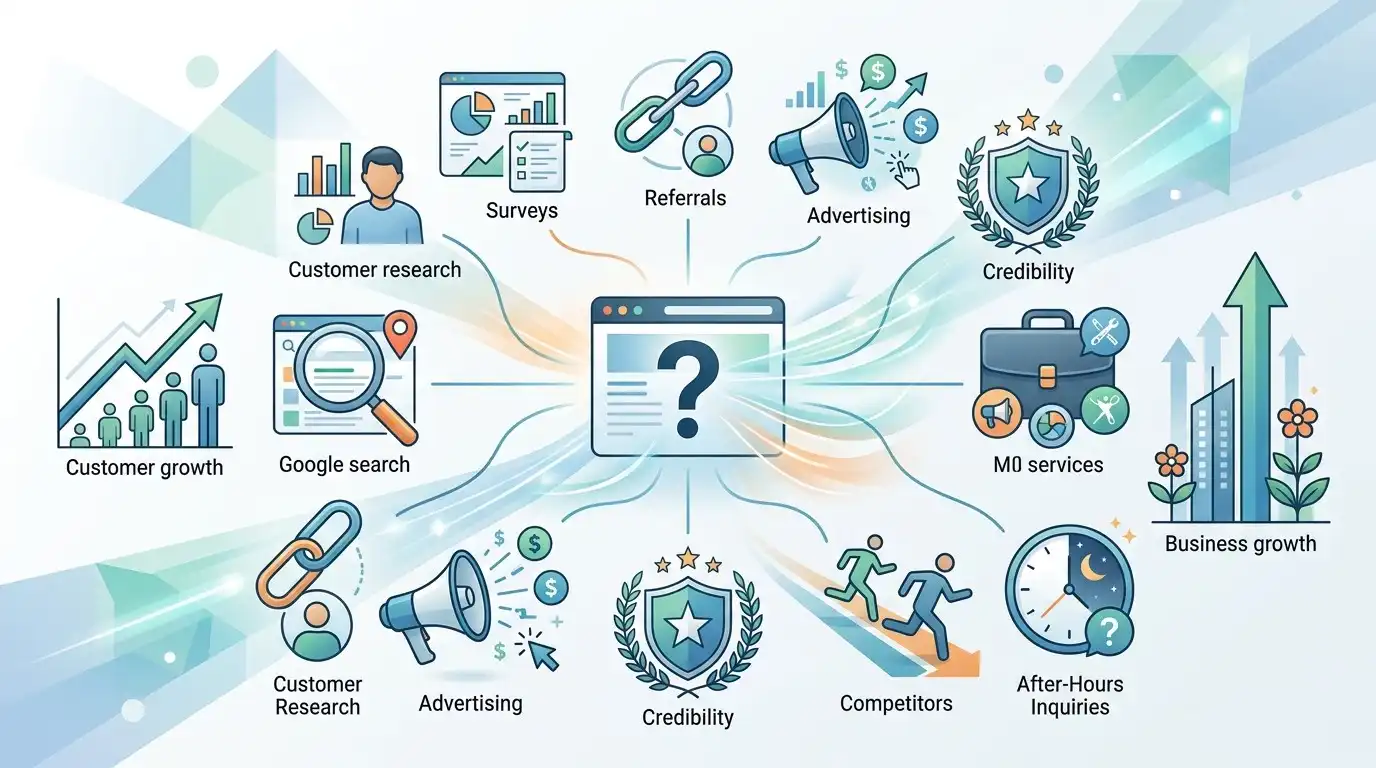
Before spending money on a website, answer these questions honestly.
1. Do you want new customers?
If your business is already completely booked and you don’t want more customers, a website may not be your most urgent investment.
But if you want to grow, a website can give potential customers somewhere to learn about you.
2. Do people search for your type of business?
Think about what someone would type into Google.
For example:
- plumber near me
- local electrician
- family dentist
- tax accountant
- roofing contractor
- house cleaning service
- personal injury lawyer
If potential customers are searching for businesses like yours, having a website gives you an opportunity to appear in those searches.
3. Do customers research you before contacting you?
This is extremely common.
Someone might hear about your business from:
- A friend
- A coworker
- A Google review
- A local group
- Another business
Then they search your business name.
What do they find?
If they find a professional website that clearly explains what you do, that’s useful.
If they find nothing except an old social media profile, you’ve made the customer do more work to figure you out.
And some people simply won’t bother.
4. Do you need to explain what you sell?
If your business has multiple services, pricing considerations, qualifications, service areas, processes, or other information customers need before contacting you, a website becomes much more useful.
5. Do you want customers to contact you outside business hours?
Your website doesn’t close at 5 PM.
Someone can visit it at 10:30 PM, read about your services, look at your work, find your phone number, submit a form, or request an appointment.
6. Do you want to advertise?
If you eventually plan to use Google Ads, social advertising, email marketing, or other campaigns, a dedicated website can give those visitors somewhere more useful to go than a social media profile.
7. Are you trying to look established?
This doesn’t mean you need an expensive website.
It means your online presence should make it easy for someone to understand:
Who are you?
What do you do?
Where do you work?
Why should I trust you?
How do I contact you?
8. Do you rely entirely on referrals?
This is where things get interesting.
You might think:
“I don’t need a website because all my customers come from word of mouth.”
But what happens after someone recommends you?
The potential customer may still look you up.
So your website doesn’t necessarily have to generate the original referral.
It can help convert the referral into a customer.
9. Are you competing against businesses that have websites?
If your competitors have professional websites and you don’t, you’re making comparison easier for them.
A potential customer might compare:
Company A
Professional website with services, photos, testimonials and easy contact.
Company B
Facebook page from three years ago.
Even if Company B provides better service, the customer doesn’t necessarily know that.
10. Do you want to build a business that grows beyond you?
A website can become more useful as your business grows.
You may eventually want:
- More employees
- More service areas
- More customers
- Online booking
- Online payments
- Lead generation
- Search traffic
- Content marketing
- Ecommerce
- Hiring pages
- Customer resources
A website can become the central place where all of those things connect.
When You Probably Should Have a Website
There are some situations where the answer is fairly straightforward.
You run a local service business
Examples include:
- Plumbers
- Electricians
- HVAC companies
- Roofers
- Landscapers
- Cleaning companies
- Contractors
- Painters
- Auto repair shops
- Pest control companies
People frequently need to understand what these businesses do, where they operate, and how to contact them.
A website is particularly useful for answering those questions.
You run a professional service business
Examples:
- Accountants
- Attorneys
- Consultants
- Insurance agencies
- Financial professionals
- Architects
- Engineers
- Marketing firms
- Real estate professionals
For these businesses, the website often does more than provide contact information.
It helps explain:
- Expertise
- Services
- Credentials
- Experience
- Areas of specialization
- Process
- Frequently asked questions
A potential client may want to research all of that before making a phone call.
You have multiple services
Suppose you’re a contractor.
Your company offers:
- Kitchen remodeling
- Bathroom remodeling
- Basement finishing
- Home additions
- Deck construction
Trying to explain all of that through a social media profile becomes awkward.
A website can give each important service its own place.
That’s better for customers and can also create more opportunities to appear for relevant searches.
You serve multiple locations
Imagine a business serving:
- Dallas
- Fort Worth
- Arlington
- Plano
Your customers may want to know whether you actually serve their area.
A website gives you room to explain your service area properly.
It can also help you organize location-specific information when that information is genuinely useful to customers.
You want customers to find you through Google
This deserves a little clarification.
A website doesn’t automatically make your business rank on Google.
Simply publishing a website doesn’t mean you’ll suddenly appear at the top of search results.
But a website gives search engines substantially more information about your business than a short social media profile or directory listing can provide.
You can create pages around:
- Your services
- Your locations
- Customer questions
- Useful resources
- Your business
- Specific problems you solve
And those pages can potentially attract organic search traffic over time.
That’s one reason the website can become much more valuable as your business’s content grows.
But What If I Already Have a Google Business Profile?
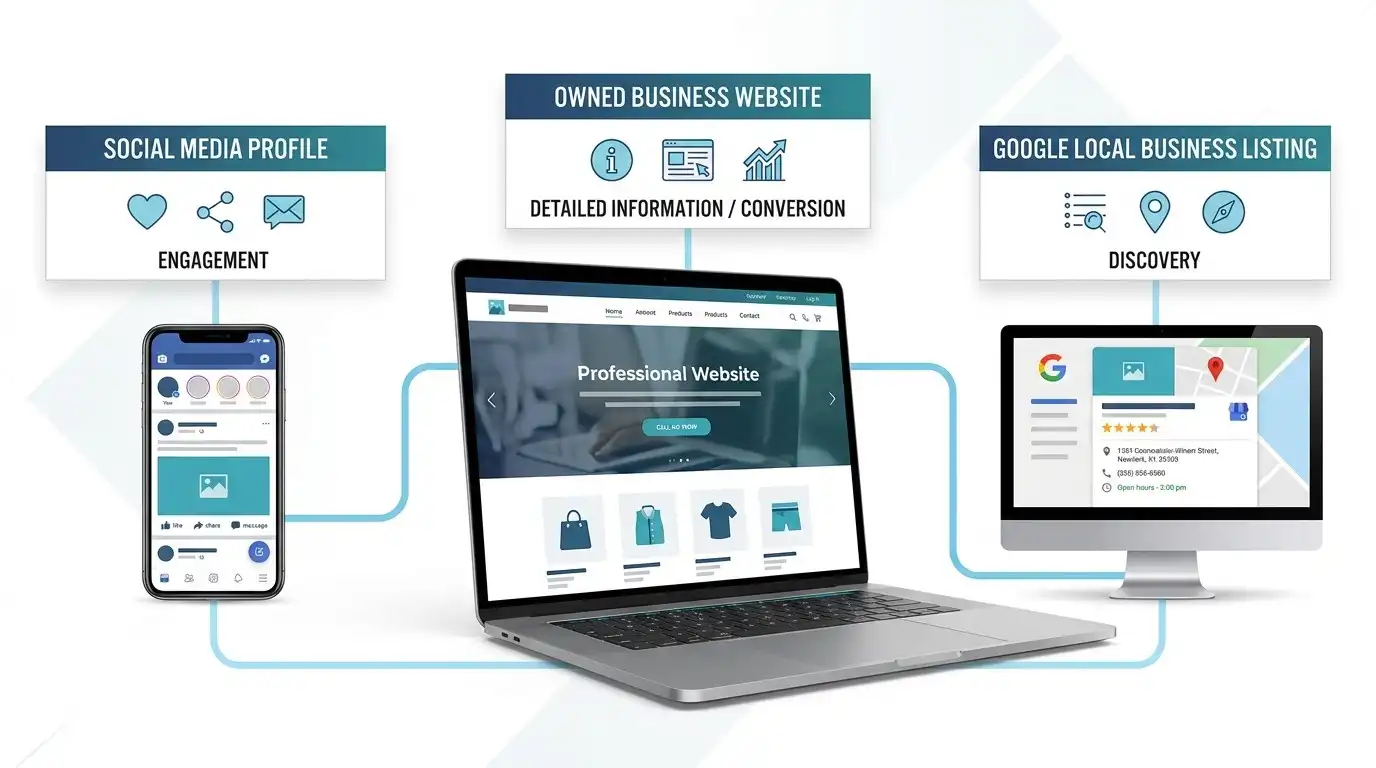
A Google Business Profile is extremely useful for a local business.
But it isn’t a replacement for your website.
Think about the two differently.
Google Business Profile
Useful for:
- Local discovery
- Maps
- Reviews
- Business hours
- Phone number
- Directions
- Photos
- Quick business information
Website
Useful for:
- Detailed services
- Service pages
- About information
- FAQs
- Case studies
- Testimonials
- Detailed contact options
- Resources
- Blog content
- Lead generation
- Search visibility
- Brand presentation
The two work well together.
You don’t have to choose one.
What If I Have Facebook and Instagram?
This is probably the most common objection.
“Why would I need a website when I already have social media?”
Because they do different jobs.
Social media is excellent for:
- Discovery
- Updates
- Photos
- Community
- Conversations
- Showing personality
- Sharing recent work
A website is better suited to being your organized home base.
Imagine that a customer wants to know:
What services do you offer?
On a website, you can send them directly to a service page.
On social media, they may have to scroll through dozens or hundreds of posts trying to find the answer.
That difference becomes increasingly important as your business grows.
The Problem With Making Social Media Your Entire Online Presence
There’s another issue.
You don’t control the platform.
You don’t decide:
- How posts are displayed
- Which followers see them
- How the algorithm works
- What features are available
- What the platform’s policies are
- How the profile looks in the future
That doesn’t mean you shouldn’t use social media.
You absolutely can.
But it is generally better to think of social media as a channel that sends people toward your business, rather than the entire foundation of your online presence.
Your website can be the place where everything comes together.
What If Most of My Business Comes From Word of Mouth?
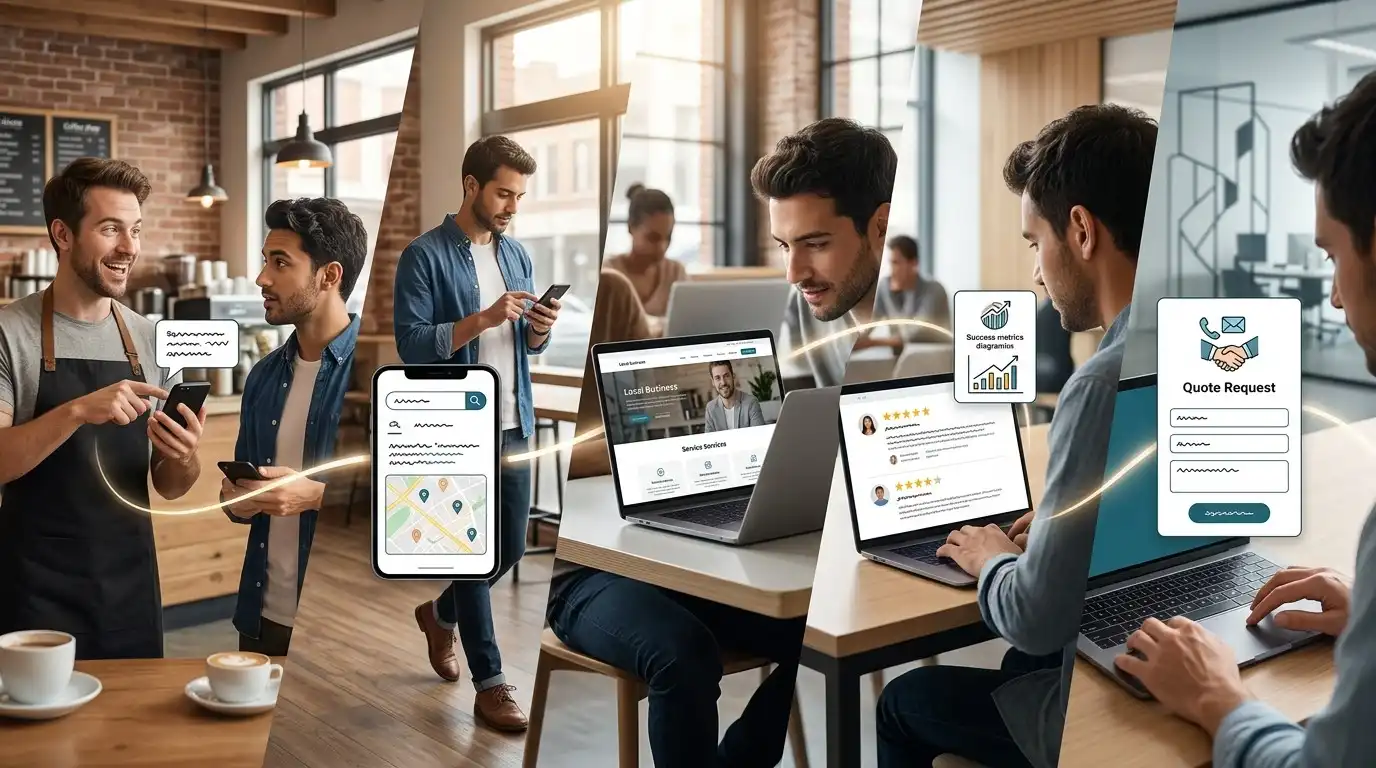
This is where the answer isn’t simply “you need SEO.”
Suppose you’re a contractor.
A customer tells their neighbor:
“You should call Mike. He did our kitchen.”
The neighbor gets Mike’s phone number.
What do you think happens next?
There is a good chance they search for Mike.
Not necessarily because they distrust the recommendation.
Because that’s simply how people research businesses now.
They may want to see:
- What does the company do?
- What kind of work do they perform?
- Where are they located?
- Do they look legitimate?
- What does their work look like?
- How can I contact them?
A website can become the second half of the referral.
The referral creates interest.
The website helps answer the questions that come afterward.
When You Might NOT Need a Website Yet
Here’s the part most web designers don’t tell you.
There are situations where building a website may not be your highest priority.
You’re still testing the business idea
If you aren’t sure whether your product or service has demand, you may want to validate the business before spending heavily on branding and web development.
A simple online presence may be enough initially.
You have no plans to grow
Suppose you run a tiny side business, have a stable group of repeat customers, and have no interest in taking on additional work.
A website may still be useful, but it may not be urgent.
You are completely booked
If you’re a solo contractor who already has more work than you can handle for the next six months, spending thousands of dollars on lead generation may not make sense right now.
Your priority might be hiring help instead.
Your customers already come from one reliable channel
Some businesses operate successfully through a very specific ecosystem.
For example, a business may receive nearly all of its work through an established referral network, marketplace, physical location, or existing customer base.
If that channel reliably supplies enough business, a website may be a lower priority.
But there is an important question to ask:
What happens if that source of customers slows down?
The Better Question: What Would a Website Actually Do for Me?
This is where I think most articles get the conversation wrong.
Don’t ask:
“Do I need a website?”
Ask:
“What job would I hire the website to do?”
For example:
Job #1: Generate phone calls
The website should make the phone number obvious and give visitors enough confidence to call.
Job #2: Generate quote requests
The website should explain the service and make requesting an estimate easy.
Job #3: Get appointment bookings
The website should make scheduling straightforward.
Job #4: Explain complicated services
The website should organize information so customers can understand what you offer.
Job #5: Build trust
The website should demonstrate experience, credibility, work quality, reviews, qualifications, and other relevant evidence.
Job #6: Get found in search
The website should provide useful, crawlable content around the services and questions your customers actually search for.
Job #7: Support referrals
The website should give people who have already heard about you somewhere to research the business.
Once you know the job, deciding what kind of website you need becomes much easier.
The Minimum Viable Website for a Small Business
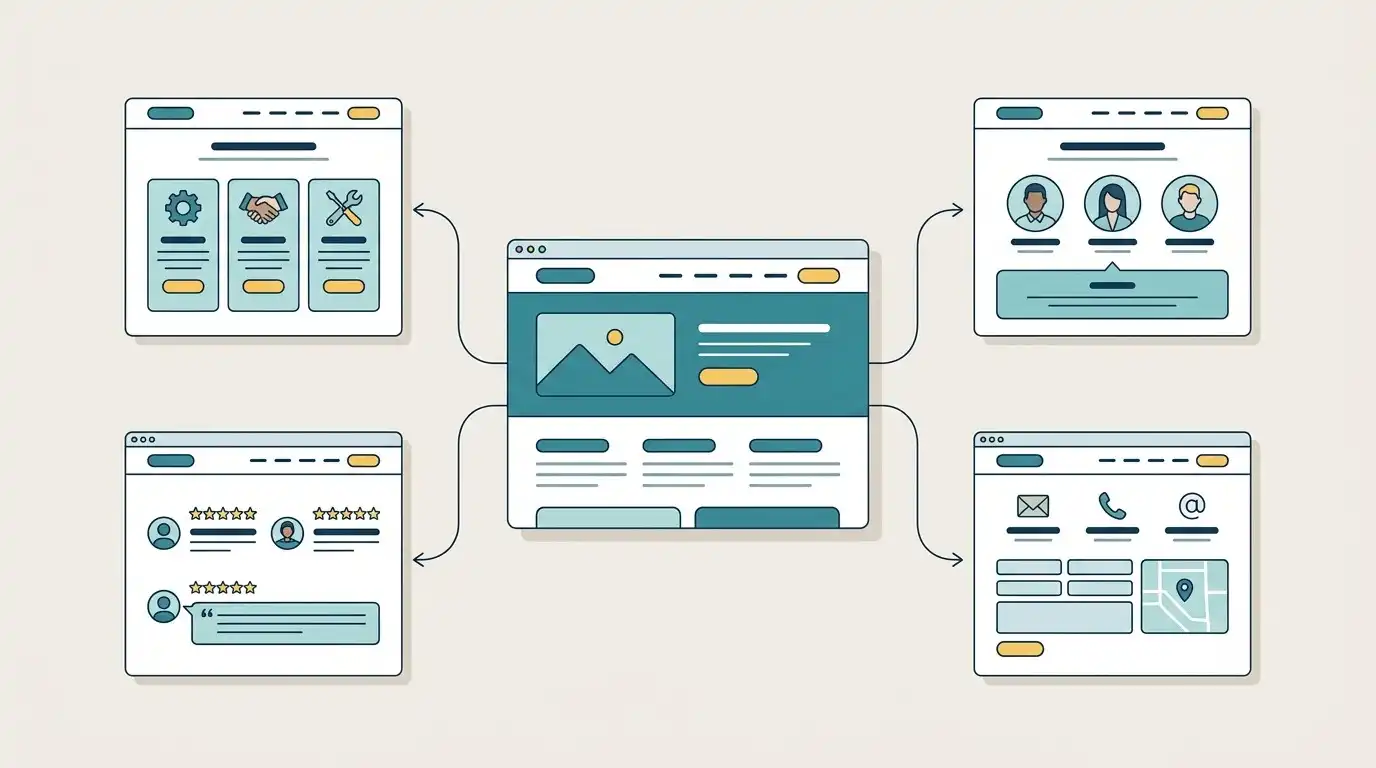
You don’t necessarily need a 30-page website.
For many businesses, a simple website can accomplish a lot.
A basic version might include:
Homepage
Explain what you do, who you serve, where you operate, and what the visitor should do next.
Services
Explain your main services.
About
Tell customers who you are and why they should trust you.
Reviews or Testimonials
Show evidence from real customers.
Contact
Make contacting you easy.
That’s it.
You can expand the website later.
The important thing is that the website should be complete enough to answer the questions your customers actually have.
One Page vs Five Pages vs Twenty Pages
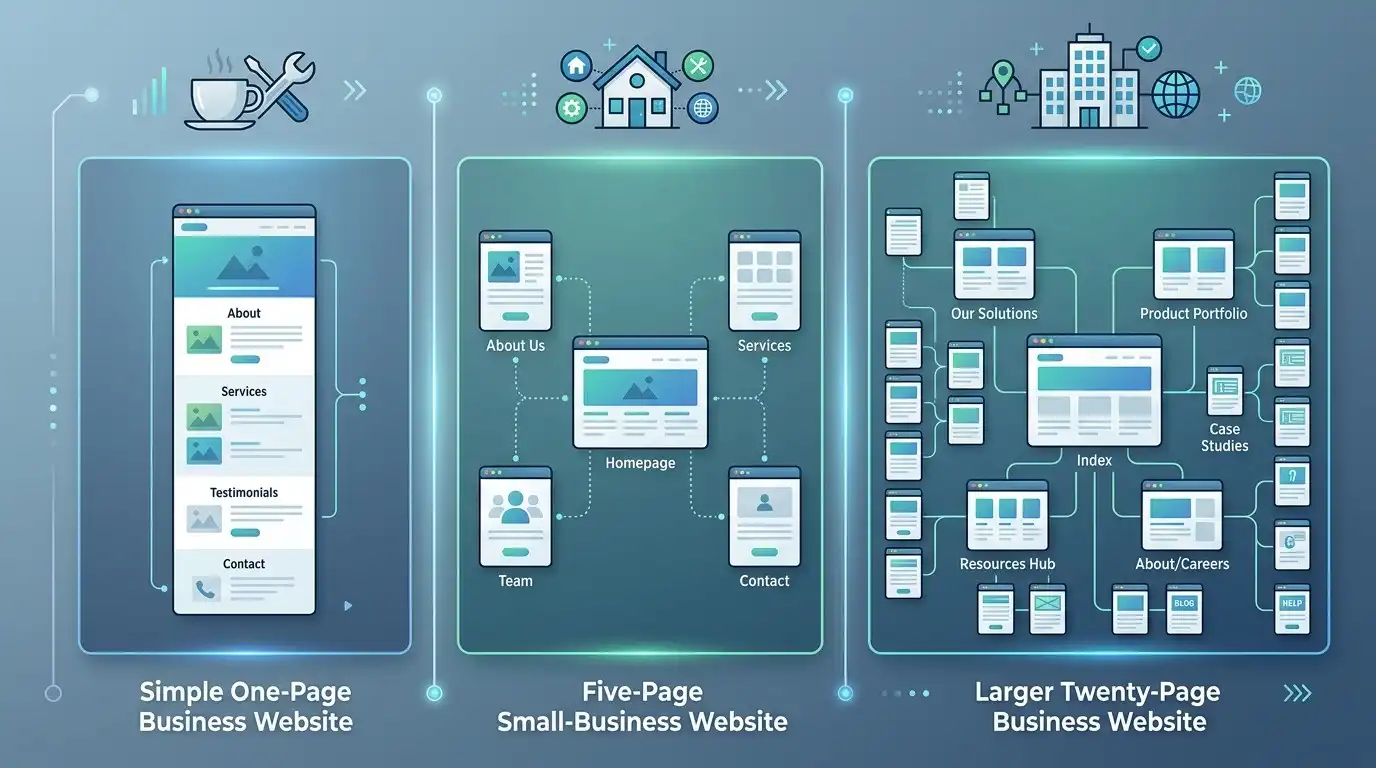
There is no magic page count.
That’s another piece of advice I would be skeptical of.
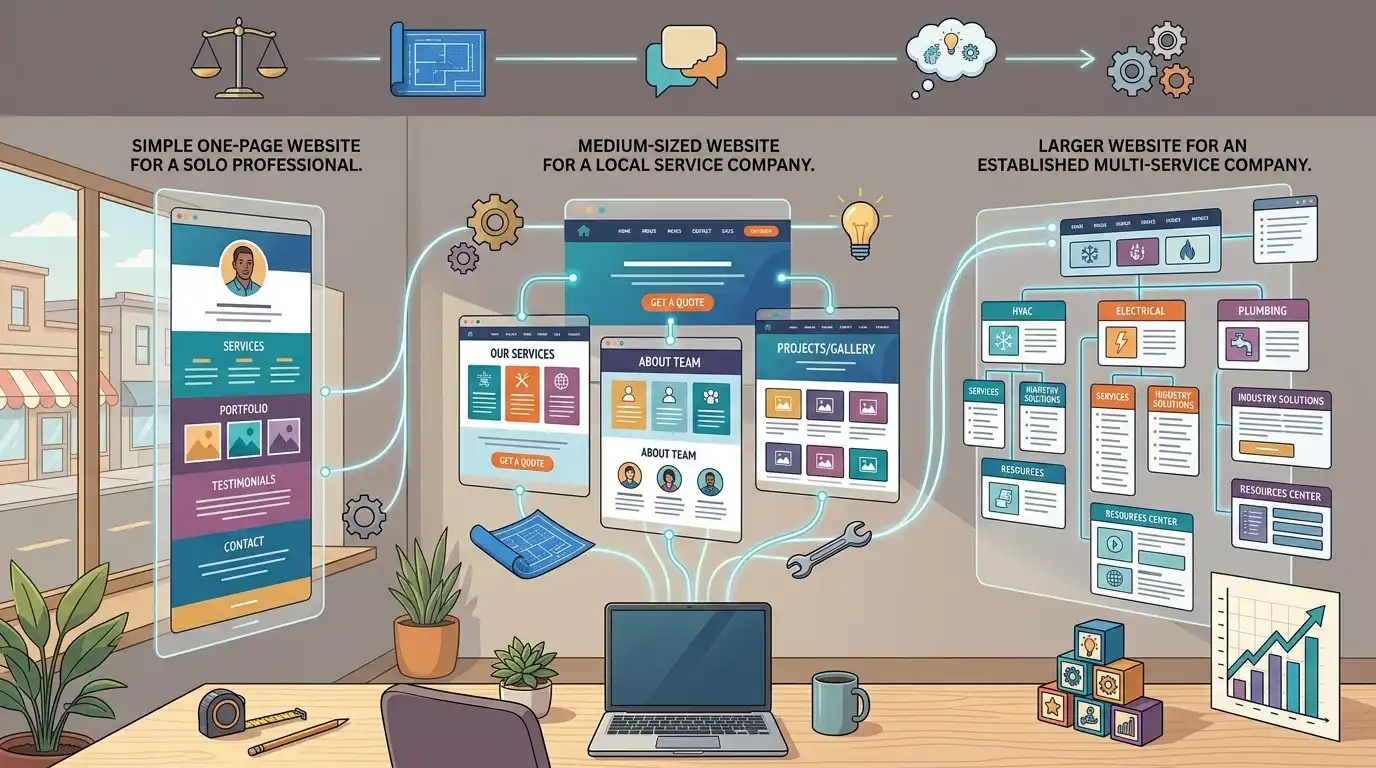
A one-page website can be perfectly reasonable for:
- A solo professional
- A simple service
- A new business
- A personal service provider
A five-page website may make sense for:
- A local service company
- A small professional firm
- A simple contractor
- A local shop
A larger website may make sense for:
- Businesses with many services
- Multiple locations
- Larger teams
- Ecommerce
- Complex organizations
- Businesses with extensive resources
Build pages because customers need the information, not because someone told you that every website needs a certain number.
The Website Decision Test
Here’s a simple way to evaluate your own business.
Give yourself one point for every statement that is true.
Customer Growth
- I want more customers.
- I want to expand into new markets or service areas.
- I want customers who don’t already know me.
Search
- People search Google for services like mine.
- My competitors appear in search results.
- I want to attract customers through organic search.
Trust
- Customers research my business before contacting me.
- My business has reviews, projects, credentials, or experience worth showing.
- I want my business to look more established online.
Sales
- Customers ask the same questions repeatedly.
- I need quote requests or leads.
- I want people to book appointments online.
- I want to sell products online.
Control
- My online presence currently depends heavily on another platform.
- I want one central place to send customers.
- I want to control how my business is presented online.
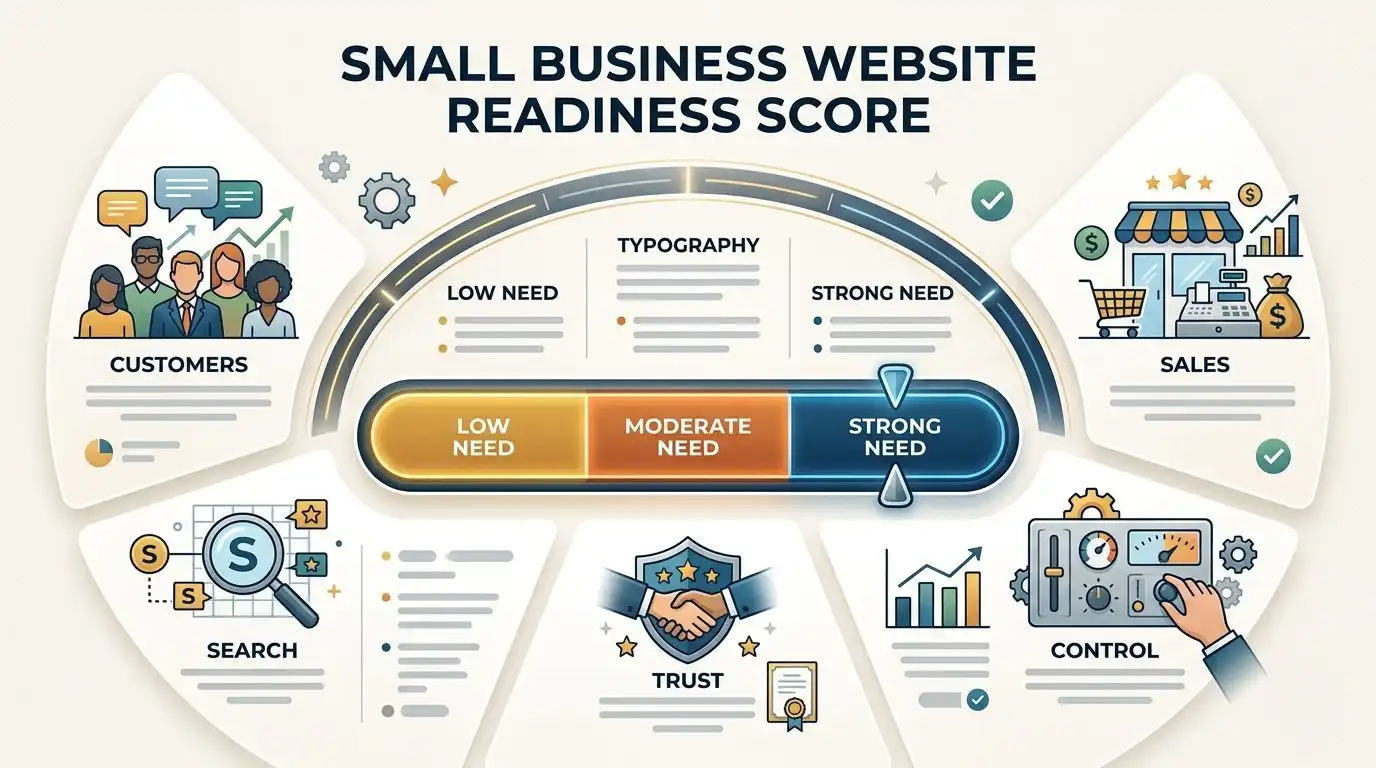
What Your Score Means
0–3 points
You may not need a full website immediately.
If your business is working well through referrals or another reliable channel, you can take your time.
But consider whether your situation is likely to change as the business grows.
4–7 points
A website is probably worth serious consideration.
You have several reasons for needing one, even if you don’t need a huge site.
A simple professional website may be enough to start.
8+ points
You’re probably leaving opportunities on the table without one.
Your business has multiple reasons to benefit from a website, whether that’s search visibility, lead generation, credibility, customer education, or reducing dependence on third-party platforms.
Here’s the Part Most Website Articles Get Wrong
They treat the decision as:
Website vs no website.
But there is actually a third option:
The right-sized website.
You don’t have to choose between:
No website
and
$15,000 custom website.
There is a huge middle ground.
A small business can start with a focused website and expand it as the business grows.
For example:
Stage 1
A simple five-page website.
Stage 2
Add individual service pages.
Stage 3
Add useful articles and FAQs.
Stage 4
Add case studies and project pages.
Stage 5
Add booking, ecommerce, integrations, or other functionality when the business actually needs them.
Your website doesn’t have to be finished forever on launch day.
What If I Already Have a Website?
This question is almost as important as whether you need one.
Having a website doesn’t automatically mean you have a useful website.
Ask:
Can someone understand what I do immediately?
Is the information current?
Does it work properly on a phone?
Are my services easy to find?
Is my phone number obvious?
Can someone easily request a quote?
Does the website reflect the business I have today?
Are there pages that haven’t been updated in years?
Does it look trustworthy?
Does it give visitors a reason to contact me?
If several answers are “no,” the question may no longer be:
“Do I need a website?”
It may be:
“Does my current website still do its job?”
That’s a very different problem.
A Website Is Not a Marketing Strategy by Itself
This is another important reality.
Getting a website does not automatically produce customers.
A website can be:
- Beautiful but invisible
- Fast but confusing
- Professional but poorly positioned
- Full of information but difficult to navigate
- Search-friendly but unconvincing
- Expensive but ineffective
A website is a tool.
Its results depend on how that tool is used.
You may also need:
- Local SEO
- Content
- Reviews
- Social media
- Advertising
- Email marketing
- Networking
- Referrals
- Strong offers
- Good sales processes
The website becomes much more powerful when it works together with those activities.
So, Do You Need a Website?
For most established small businesses that want to attract new customers, yes, having a website is a sensible investment.
But “yes” doesn’t mean:
Build the biggest website possible.
It means:
Build the website your business actually needs.
If you’re a solo service provider with a straightforward offering, you may only need a small website.
If you’re an established company with multiple services and locations, you may need considerably more.
If you’re still testing a business idea, you may be able to wait.
If you’re already overwhelmed with customers, a website may not be your most urgent expense.
The right answer depends on what you’re trying to accomplish.
The Real Test
Here’s the simplest test I can give you:
Imagine a potential customer hears your business name tomorrow.
They don’t know you.
They don’t know how good you are.
They don’t know what you charge.
They don’t know exactly what you do.
They search for your business.
What do you want them to find?
If the answer is:
“A place that clearly explains my business, shows them why they should trust me, answers their questions, and gives them an easy way to contact me.”
Then you probably want a website.
Not because every business is required to have one.
Not because someone on the internet said websites are important.
And not because a web designer wants to sell you one.
Because your customers need somewhere to go.
Frequently Asked Questions
Do small businesses still need websites in 2026?
Many do, particularly businesses that want new customers, search visibility, lead generation, credibility, or a central place to explain their services. However, a website isn’t equally urgent for every business.
Can I run a business without a website?
Yes. Some businesses operate successfully through referrals, social media, marketplaces, physical locations, or other channels. The question is whether those channels are enough for your current and future goals.
Is Facebook enough for a small business?
A Facebook page can be useful, but it generally shouldn’t be considered a complete replacement for a website. Social media is useful for discovery and engagement, while a website gives you a dedicated place to organize your services, information, content, and contact options.
Is Instagram enough for a business?
Instagram can be extremely useful for businesses that rely heavily on visual content, but it has limitations as the sole source of business information. A website gives customers a more organized place to learn about your services and contact you.
Do I need a website if I have a Google Business Profile?
A Google Business Profile and a website serve different purposes. Your Business Profile is valuable for local discovery, Maps, reviews, hours, and quick information. Your website can provide much more detailed information about your business and services.
Do I need a website if most of my customers come from referrals?
Not necessarily, but a website can help convert referrals. People who receive a recommendation often research the business before making contact.
Does a website guarantee that I will rank on Google?
No. Having a website is not a guarantee of search rankings. Ranking depends on many factors, including relevance, content quality, competition, technical factors, authority, location, and the specific search.
Does a one-page website work for a small business?
It can. A one-page website may be perfectly appropriate for a business with a simple offering. As the business grows or its services become more complicated, additional pages may become useful.
How much does a small business website cost?
There is no universal price. A simple DIY website can cost relatively little, while professional small-business websites can cost several thousand dollars. More complex projects can cost considerably more. The right budget depends on the work the website needs to perform.
Should I build a website before I start my business?
Not always. If you’re still validating the business idea, you may want to start with a simple online presence and invest more once you’ve confirmed demand. If you already know what you’re selling and need customers, launching a website earlier may make sense.
What should a small business website include?
At minimum, it should clearly explain what the business does, who it serves, where it operates, why customers should trust it, and how to contact it. The exact pages depend on the business.
Final Thought
A website isn’t a badge that proves you’re a “real” business.
It’s a tool.
For one business, that tool might generate leads every day.
For another, it might mainly help referrals research the company.
For another, it might sell products.
For another, it might answer questions and reduce phone calls.
And for a brand-new business that hasn’t figured out its market yet, it might not be the most important thing to build today.
Don’t build a website because you think you’re supposed to have one.
Build one when you know what you want it to do.
Then build the smallest, clearest, most useful version that can do that job.
And expand it when your business gives you a reason to.